Construction Bookkeeping: A Practical Guide for Contractors
Construction bookkeeping means tying every dollar in and out to a specific job, then tracking what you have billed, what you have collected and what you still owe. Generic books tell you whether the business made money. Construction books tell you which jobs made money, and whether you can cover payroll next Friday.
This guide covers the setup a small contractor needs, how to handle progress draws and retainage, which accounting method to ask your CPA about, and how to keep cash flowing while you wait to get paid.
Keep progress billing moving. Create quotes, manage progress draws, and take client payments from your mobile device, even when your crew has limited internet connectivity. Explore AeroInvoice
TL;DR
- Give every job a number and tag every expense to it, using a short list of categories: labor, materials, subcontractors, equipment and overhead.
- Billed is not the same as collected. Track invoice age, retainage and actual payment dates, not just revenue.
- Your tax accounting method is not a copy-and-paste choice. Have a construction CPA confirm it for your entity and contracts.
- Forecast your cash gap before you accept a bigger job, because progress payments rarely line up with what you owe suppliers and crews.
- Keep field evidence (quantities, delivery tickets, photos, signed change orders) matched to each billing line.
Table of Contents
- What makes construction bookkeeping different
- Set up job costing you will actually use
- Progress draws, retainage and the paperwork behind them
- Which accounting method fits a contractor
- Working capital: billed money versus cash you can use
- Our perspective: bookkeeping starts in the truck
- A weekly routine that keeps the books honest
- Where AeroInvoice fits
- Common mistakes to avoid
- FAQ
- Sources
What makes construction bookkeeping different
A retail shop sells a product and gets paid. A contractor spends money for weeks, bills in stages, and may wait on an owner, a lender or a general contractor before cash arrives. Three things follow from that.
- Costs belong to jobs. Labor, materials, subs and equipment all need a job attached, or you cannot tell a good job from a bad one until it is too late.
- Revenue arrives in pieces. Deposits, progress draws, change orders and retainage each have their own timing.
- Profit is a moving estimate. Until the job closes, profit depends on what is left to spend, not just what you have already spent.
The IRS Construction Industry Audit Technique Guide describes the same reality from the tax side: the contract terms, including how much and how often you are paid, drive how income is recorded.
Set up job costing you will actually use
According to Autodesk’s construction accounting guide, job costing splits a project into tasks or phases and uses cost codes to show which activities and materials are driving cost. For a small shop, the guide’s takeaway is practical: more granular codes give better visibility, but too many codes cause field-entry errors. The right level is the one your crew can apply every time.
The minimum structure
Start here and add detail only when you need it:
- A job number on every estimate, invoice, receipt, timesheet and mileage entry.
- Five cost categories: labor, materials, subcontractors, equipment, overhead.
- A phase for jobs longer than a few weeks (demo, rough-in, finish, punch list).
If a foreman has to think about which code to pick, the list is too long. A wrong code entered on site is worse than a broad one entered correctly.
Compare three numbers on every job
For each active job, keep these side by side:
| Number | What it tells you |
|---|---|
| Estimated cost | What you planned to spend |
| Cost to date | What you have actually spent |
| Billed to date | What you have invoiced, including retainage held |
Add a fourth, estimated cost to complete, once you are past the halfway mark. If cost to date is climbing faster than the percent of work done, you are losing margin now, not at closeout.
Progress draws, retainage and the paperwork behind them
Progress billing lets you invoice at each stage instead of waiting for the end. Done well, it keeps your cash from running dry. Done badly, it creates disputes and rejected applications.
Most failures happen in the documentation, not the math. Take a public-works example: the University of Tennessee’s progress payment procedure asks for a schedule-of-values continuation sheet, sequential application numbers, line-item percentages, evidence for stored materials and separate treatment of retainage. Private owners and lenders are often less formal, but the habits carry over.
A draw checklist
- Build a schedule of values from your estimate, one line per phase or trade.
- Number each application in order and show percent complete per line.
- Show retainage as its own line, not netted into the total.
- Attach proof: daily quantities, delivery tickets, photos and approvals.
- Get change orders signed before you bill for them.
- Record the date the money actually lands, not just the invoice date.
The last item matters more than it looks. Procore’s contractor-finance guidance makes the point that growing receivables from progress billing is not the same as better cash flow. An old receivable carries collection risk and may not cover payroll or suppliers. Watch invoice age, approval status, retainage and payment dates.
Retainage needs its own tracking
Retainage is money you earned but cannot touch yet. Book it as a receivable tied to the job, note the release terms in the contract, and put the expected release date on your calendar. Many small contractors lose track of it because it sits quietly inside the billed total. A short list of open retainage by job, reviewed monthly, fixes that.
Which accounting method fits a contractor
This is the part not to guess at. The IRS guide explains that Section 446 allows cash, accrual and other permitted methods, and that long-term contracts can bring completed-contract or percentage-of-completion rules into play. Which one applies depends on your entity type, gross receipts, inventory and the characteristics of the contract.
So do not copy the setup of the contractor down the road. Sit down with a CPA who works with construction companies, bring your last two years of job reports and ask three things:
- Which method are we allowed to use, and which is best for us?
- How should we treat retainage, stored materials and change orders?
- What do you need from me during the year so tax time is not a scramble?
Your bookkeeping should produce clean, job-level records that make that conversation short.
Working capital: billed money versus cash you can use
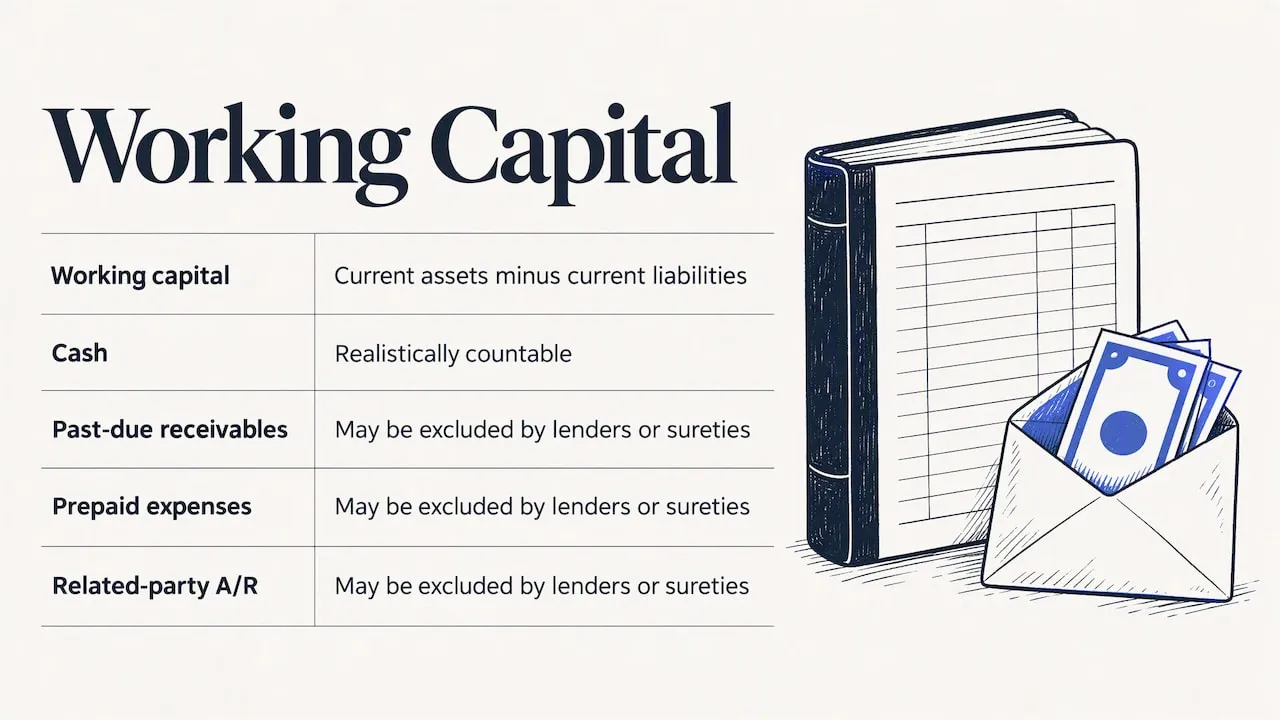
A full backlog can still leave you short. Working capital is current assets minus current liabilities, but Baker Tilly points out that lenders and sureties may exclude assets they consider unreliable, such as past-due receivables, prepaid expenses and related-party receivables. Your books need to separate money that is theoretically owed from cash you can realistically count on.
Forecast the gap before you say yes
Before you accept a larger job, do a quick cash forecast. CFMA recommends listing expected cash outflows and inflows in advance and recalculating available operating capital regularly. Progress invoices are estimates of work completed. They may not match the wages, materials, overhead, equipment, taxes and subcontractor payments already due.
Here is a simple way to run it:
- List every expected payment out by week: payroll, materials, rentals, insurance, sub payments.
- List every expected payment in by week, based on how this payer actually pays, not on the contract’s due date.
- Subtract retainage from the money coming in.
- Run the cumulative total. The lowest point is the gap you need to fund.
If that gap is bigger than your cash and credit line, negotiate a larger deposit, tighter draw schedule or a smaller scope. Better to learn it on paper than in week six.
Habits that shorten the wait
- Invoice the day a milestone is done, from the jobsite.
- Send a payment link with every invoice so the client can pay the same day.
- Follow up on anything past terms within a week.
- Review an aging report every Friday.
Our perspective: bookkeeping starts in the truck
We built AeroInvoice by watching contractors lose time and money on the same few things. Receipts pile up in a glovebox. Quotes get written at night from memory. A finished phase waits days for an invoice because the contractor is on the next job and has no signal.
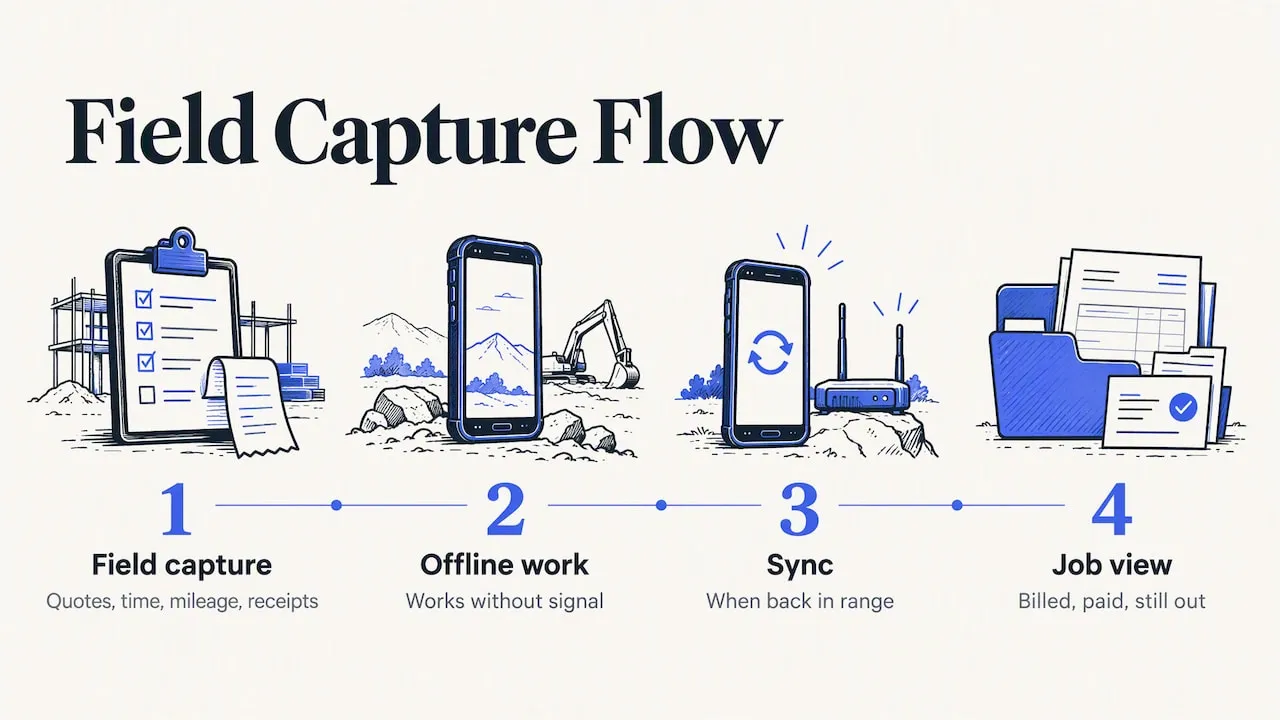
Our view is that most bookkeeping problems are really capture problems. If the invoice, the time, the mileage and the receipt are recorded where the work happens, the books mostly take care of themselves. That is why AeroInvoice works offline and syncs when you are back in range, and why the job is the center of everything: quotes, progress draws, expenses and payments all hang off it.
We also think a small contractor should not need a full accounting department to know where they stand. A clear view of what is billed, what is paid and what is still out, by job, answers most of the questions that keep owners up at night. For the rest, a bookkeeper and a construction CPA are worth every dollar, and the cleaner your job-level records, the less you pay them to untangle.
— User
A weekly routine that keeps the books honest
You do not need hours. You need the same short block every week.
Daily (5 minutes)
- Snap receipts and tag them to a job.
- Log time and mileage before you leave the site.
Weekly (30 to 45 minutes)
- Send invoices or draw requests for finished milestones.
- Review unpaid invoices by age and chase the oldest.
- Match bank deposits to invoices.
- Check that every expense has a job and a category.
Monthly (about 1 hour)
- Compare estimated cost, cost to date and billed to date for each open job.
- List open retainage and release dates.
- Update your cash forecast for the next eight to twelve weeks.
- Send your bookkeeper or CPA a clean package of reports.
Where AeroInvoice fits
AeroInvoice is not a replacement for your CPA, and it is not a full general ledger. It handles the part of bookkeeping that starts in the field: quotes, invoices, progress draws by project, expense tracking, time and mileage, and online payments through Stripe with no extra fees from us. It works offline, and it comes with 142 trade templates so you are not starting from a blank page.
Plans are simple. Free is $0 per month for up to 5 documents a month, Pro is $15 per month and Business is $29 per month, and both paid plans are unlimited. You can see the details on the pricing page, or create your free account and send your first progress invoice from your phone.
Common mistakes to avoid
- Mixing personal and business money. Open a separate business account. It makes everything else easier.
- Booking materials to overhead. If it went into a job, it belongs to that job.
- Billing before approval. An invoice nobody approved is a receivable you cannot count on.
- Skipping change order paperwork. Verbal approvals turn into unpaid work.
- Waiting until tax season. Catching up on twelve months of receipts means guessing, and guesses cost you deductions and accuracy.
- Over-building the chart of accounts. Complexity nobody follows is worse than simplicity everyone does.
FAQ
Do I need a bookkeeper, or can I do it myself?
Many one-truck and small-crew contractors handle day-to-day capture themselves and hire a bookkeeper once job volume, payroll or subs make the books slip. A bookkeeper who knows job costing and retainage is worth more than a generalist. Either way, a construction CPA should confirm your accounting method.
What should a construction bookkeeper track?
Project-related expenses, payroll, invoices, cash flow and bank reconciliations, all tied to jobs. On top of that, they should track retainage, change orders, billed versus collected and estimated cost to complete. Clean job-level data is what lets you compare jobs and spot a losing one early.
Is cash or accrual accounting better for contractors?
It depends. The IRS allows several methods, and eligibility turns on entity type, gross receipts, inventory and contract characteristics. Ask a construction CPA to confirm which method applies to you instead of copying another company’s setup.
How do I improve working capital as a contractor?
Invoice at each milestone, collect by payment link, chase aged receivables weekly and forecast your cash gap before taking on larger work. Negotiating deposits and shorter draw cycles also helps. Track actual payment dates so you plan around how clients really pay.
Sources
- Construction Industry Audit Technique Guide, IRS
- The Ultimate Guide to Construction Accounting, Autodesk Digital Builder
- UT Progress Payment Procedures, University of Tennessee
- A Contractor’s Guide to Working Capital, Procore
- Working capital is a key financial indicator for construction companies, Baker Tilly
- Estimating Working Capital Capacity, CFMA